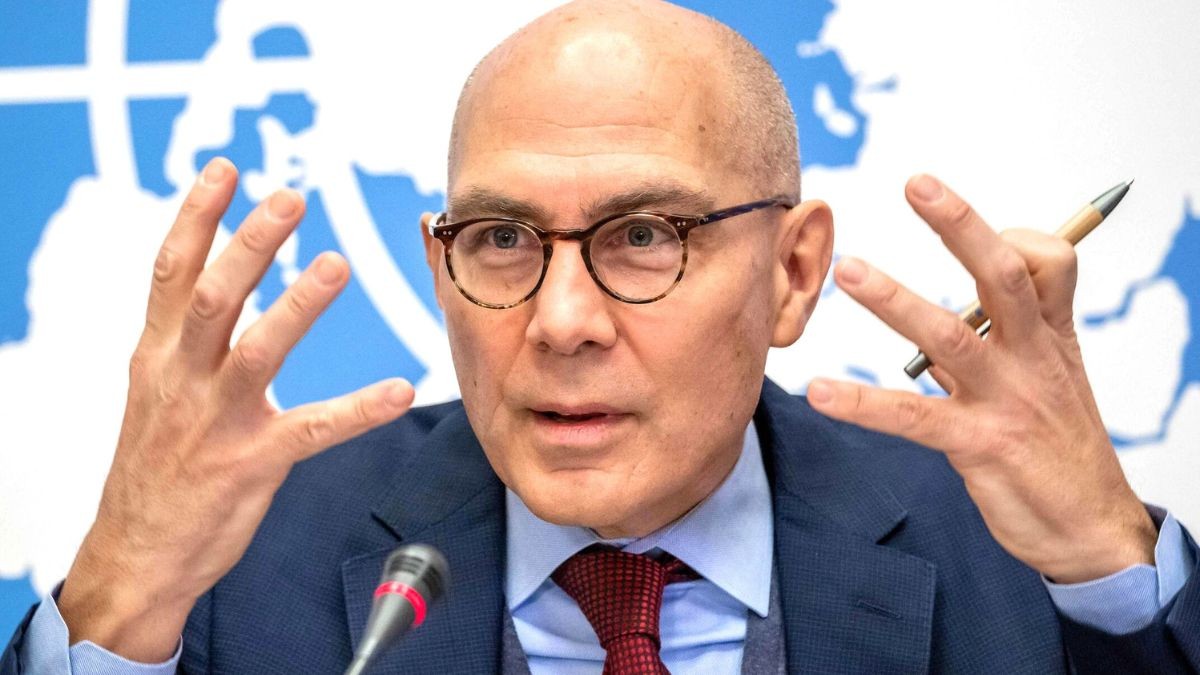
Publishing its 08 August dated, unedited advance situation report of Sri Lanka on 13 August with UN symbol A/HRC/60/21, the press release from the office of the HCHR says, the “UN Human Rights Office calls on Sri Lanka’s Government to seize the historic opportunity to break with entrenched impunity, implement transformative reforms, and deliver long-overdue justice and accountability for serious violations and abuses committed in the past, including international crimes.”
The report calls for serious reforms in the security sector and also far reaching reforms in constitutional, legal and institutional sectors. Having visited Sri Lanka almost 02 months ago, UN High Commissioner for Human Rights Volker Türk, seem to believe, Sri Lanka has a “historic opportunity now” to break from the past, “with the leadership pledging a fresh direction on long-standing issues, including delivering justice to victims, restoring the rule of law, and eliminating discrimination and divisive politics”.
His rhetoric apart, wonder what made Türk believe, the present (JVP/NPP) leadership has pledged a fresh direction on long-standing issues, while backtracking on the pledge to repeal the PTA completely and worst, using it as they wish to arrest citizens on politically decided, fictionalised suspicions.
Not the only one, take this case of a 21 year old youth, Mohamed Suhail for example. Arrested in the vicinity of the Israeli Consular’s residence in Dehiwala in October 2024, for not having the NIC with him, he was released when the NIC was produced to Courts, only to be arrested yet again under the PTA for an Instagram post that showed the Israeli flag being trampled. Held in remand prison for 09 months without any charges, he was provided bail on 15 July when police informed Court, they have no evidence of him committing any offence.
A case study of a Colombo based HR activist Ruki Fernando records 12 arrests and detentions under the PTA, since JVP/NPP leader Anura Kumara Dissanayake was sworn in as president. (Check reference here – https://www.worldpulse.org/story/the-story-of-a-young-man-held-for-9-months-under-the-prevention-of-terrorism-act-70911 ). If that is any “fresh direction”, it is definitely inhumanly repressive.
Sri Lankan political leaderships to date, has showed little interest in resolving war related issues during and after the war, except when Sri Lanka agreed to co-sponsor UNHRC Resolution 30/1 in March 2016, with Mangala Samaraweera as Foreign Minister fiercely pushing for international collaboration, with his close affinity to the US. He argued, compromising on investigating war crimes and crimes against humanity would create better space in the international arena for economic growth. Resolution 30/1 thus made Sri Lanka responsible for 05 broad themes covering, 1. Transitional justice and reconciliation 2. Rights and rule of law 3. Security and demilitarisation 4. Power sharing and 5. International engagement.
Go back 07 years, you would see an idling “Office on Missing Persons” (OMP), and nothing more. The OMP established in February 2018 was a lost cause for mothers and wives who kept agitating for information about their involuntarily disappeared family members during and after the war. Even before, when President Rajapaksa’s high powered investigative committee the “Lessons Learnt and Reconciliation Committee” (LLRC) chaired by former Attorney General and much respected legal luminary PC Chitra Ranjith de Silva handed over its final report that was tabled in parliament in December 2011, the Rajapaksa government was not prepared to carry through any of its recommendations. In fact UNHRC Resolutions 40/1, 46/1 and 51/1 called for implementation of the LLRC recommendations the Rajapaksa government totally ignored.
What is not read about Sri Lankan politics by the Tamil Diaspora is, North-East boycotting elections or not, governments are formed in the Sinhala South that caters to the dominant Sinhala-Buddhist social ideology. That ideology needs to be engaged with, for any UN Resolution to be carried through by any government in Colombo.
UNHRC resolutions adopted are not legally binding on the country. Yet, as a UN agency established in 2006 with 47 member nations, the UNHRC was expected to be far more effective and persuasive than the Commission on Human Rights (CHR) established in 1946. UNHRC is mandated to promote and effectively uphold “universal respect for the protection of all human rights and fundamental freedoms for all” and “address situations of violations of human rights, including gross and systematic violations, and make recommendations thereon”.
Pre-UNHRC period in 70′ and 80’s the UN’s role against apartheid was constructively assisted by the CHR in enforcing economic sanctions and encouraged divestment from South Africa since 1974 to cripple the apartheid economy and also in enforcing an arms embargo in 1977. They in particular were of immense support to the struggling Black South Africans in dismantling the “White” apartheid regime. It was definitely global lobbying and pressure that left the South African apartheid regime completely isolated with the International Olympics Committee banning apartheid South Africa from participation in Olympic games, the Commonwealth of Countries signing the “Gleneagles Treaty” to boycott sports and the ICC banning playing cricket with South Africa.
Coming back to the present, that tradition of completely isolating a “butcher State” from the civilised, peaceful world has not been how Israel is treated by the UN and its affiliates, since Israel was carved out in 1948 from Palestinian land. How do you see Israel when records say UN Security Council was compelled to adopt 288 Resolutions against Israel since 1948? And the UNHRC had adopted 98 Resolutions against Israel, since the UNHRC was established in 2006? How do you explain these resolutions lying idle, while Israel continue to forcibly occupy Palestinian land, displace civilians, establish Israeli settlements on forcibly occupied land, destroy Palestinian life and property, leave thousands of children and mothers starving, with the Western power bloc accepting the Israeli argument that it is the “Israeli right to defend itself?”
Here are three cases, where the UN and its agencies along with the UNHRC (including former CHR) have adopted three different approaches. First is apartheid South Africa. There were no vested interests in the West that wanted an apartheid regime in South Africa. The UN and its affiliates therefore could take decisions and have them implemented without opposition. The next two cases – Israel and Sri Lanka – are different, with vested interests in the West organising pressure on permanent members of the UN Security Council holding veto power, except on China. With Israel, it is well organised Jewish industrial power in the West, maintaining a tight grip on Western economies that decide what’s good for Israel. As for Sri Lanka, it is the growing numerical strength of the Tamil Diaspora in the West that now influences their election results, who demands the “Sinhala” government in Colombo should accept UNHRC Resolutions they want implemented. With Israel, it is about a UN that adopts Resolutions and then leave them idling and with Sri Lanka, it is about a UN that keeps lobbying to implement Resolutions they adopt.
We thus have UN agencies that weep over Gaza massacres, over killing of thousands of innocent civilians, mostly women, infants and children, demolishing hospitals and resident apartments, disrupting and attacking distribution of emergency aid and food, while the UN Security Council (UNSC) mulls over ceasefire agreements between Israel and Hamas since 2023 October. We have a UN with its Secretary General left helpless and calling for an independent investigation on Israeli shooting at starving civilians crowding for food at an emergency humanitarian aid centre. ( https://www.aljazeera.com/news/2025/6/2/israeli-forces-kill-more-people-near-aid-site-in-gaza-as-un-demands-probe )
We also have a UN with its Commissioner for HR believing it is more important to visit Sri Lanka than the bleeding and starving Gaza and inform the world, the Tamil Diaspora in particular, Sri Lanka is on a new path, with a “historic opportunity now” to break from the past, “with the leadership pledging a fresh direction on long-standing issues, including delivering justice to victims, restoring the rule of law, and eliminating discrimination and divisive politics”.
I wish to therefore ask UN High Commissioner for Human Rights Volker Türk, “how long more should we keep listening to these UN rhetoric, that has no relevance to the situation on the ground, that demand immediate answers to bleeding and starving human tragedies?”
Kusal Perera
2025 August 14